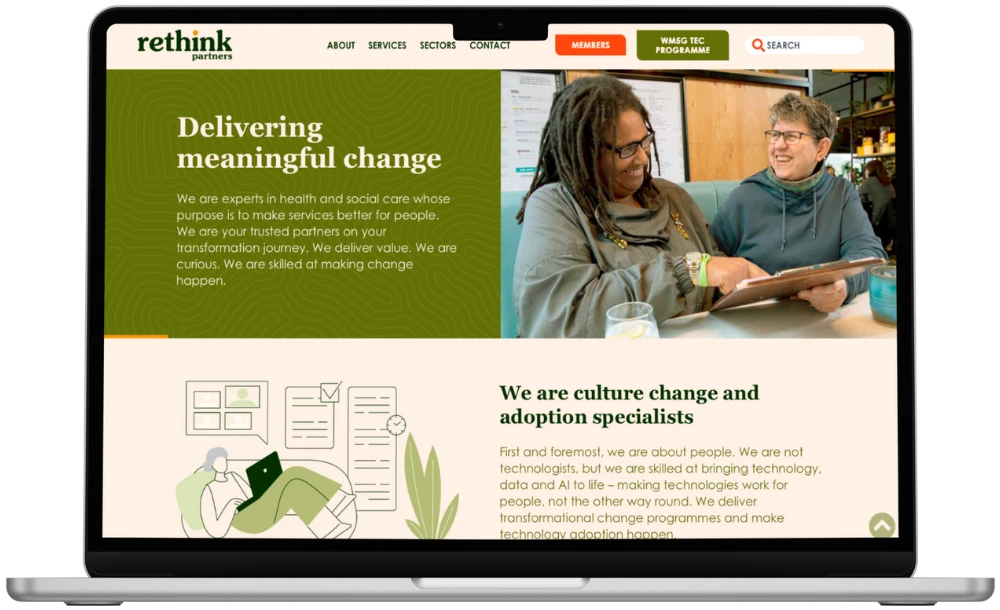
Rethink Partners required a digital platform that reflected its role as a strategic consultancy working across social innovation, care and systems change. The project combined a full website redesign with brand refinement and the development of a membership area to support knowledge sharing, resources and ongoing engagement.
WHAT WE DID FOR RETHINK PARTNERS:
Working hand in hand with the Rethink Partners team, we took a staged and collaborative approach. This began with refining the brand, clarifying messaging and visual direction to ensure consistency across all touchpoints. From there, we redesigned and rebuilt the website to better communicate the organisation’s expertise, services and impact. A key part of the project was the development of a membership area, providing a structured space for exclusive content, resources and insights. Throughout the process, we maintained clear communication, shared decision-making and full transparency around scope, timelines and progress.
IN CONCLUSION
The result is a confident, purposeful digital platform that supports both public-facing communications and deeper engagement through membership. Strategic website design and brand transformation have given Rethink Partners a strong foundation for growth, collaboration and influence.
A consultancy working across social innovation, care and systems change has a hard story to tell. The work is complex, relationship-led and long term. It rarely fits into a neat list of services.
Rethink Partners needed a website that could explain this clearly to people meeting the organisation for the first time. It also needed to give existing contacts a reason to return. That meant the brand, the words and the site structure all had to pull in the same direction.
Our approach
We worked in stages so each decision built on the last. Brand and messaging came first, because a website can only be as clear as the thinking behind it. A project like this usually follows steps such as these:
Agree who the site must serve, from new contacts to existing members.
Settle the key messages and visual direction before design begins.
Plan the page structure and the member journey together, not as separate jobs.
Design, build and test the public site and the membership area.
Review progress regularly, with scope and timelines kept open.
What changed
We have not put numbers on this page, and we won't make any up. What we can describe is the shift in how the organisation shows up online.
Rethink Partners now has one consistent identity across its touchpoints. The website explains its expertise, services and impact more clearly. The membership area gives exclusive content, resources and insights a proper home, so engagement can carry on after a first visit.
For a project like this, success looks like visitors understanding what the organisation does within moments. It also looks like members finding what they need without help, and a team that feels proud to point people to its site.
What other organisations can learn
Whether you are a consultancy, a charity or a care provider, a few lessons apply.
Sort out your message before you sort out your design. Unclear words make even a beautiful site hard to use.
Treat a membership area as part of the website, not an add-on. The public and private sides should feel like one experience.
Decide what members get that others don't, and plan how you will keep it fresh.
Think about data protection early. Logins and member details need careful handling under GDPR.
Pick a partner who is open about scope, timelines and progress. Surprises are expensive.
Frequently asked questions
How long does a website and membership area project take?
It depends on the size of the site, how much content you have and which member features you need. We agree a realistic timeline at the planning stage and keep you updated as the work moves forward.
Do we need to refresh our brand before redesigning our website?
Not always. But if your messaging or visual identity feels unclear or inconsistent, fixing that first usually saves rework later. We can review what you have and tell you honestly what is worth changing.
What should a membership area include?
Start with a clear reason to join, simple login and well-organised resources that are easy to search. It should also be easy for your team to add and update content without technical help.
How do you handle data protection for member areas?
We plan for GDPR from the start. That means collecting only the information you need, being clear about consent and building in secure logins. You should still take advice from your own data protection lead or legal adviser.